SECOND COAT
An artifact from a growing fictional universe.
My entry in the Jamverse Jam, a shared-world fiction and art competition from Protocolized, the magazine and media hub for the Protocol Institute.
Find the code and other project files on my Github.
Civic communications in Mayaford may not be what they appear.
Concept
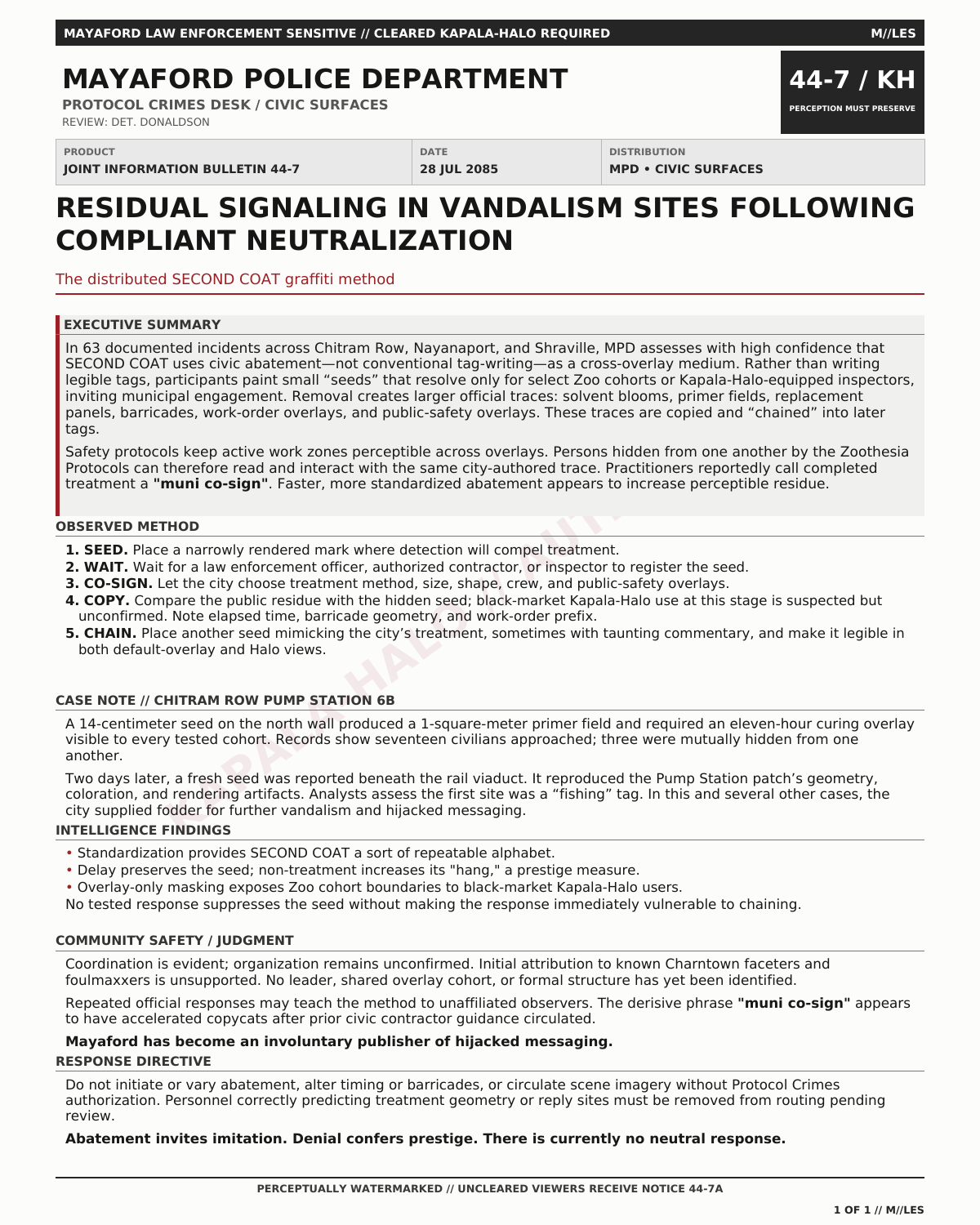
SECOND COAT is a new graffiti method in Mayaford that baits the city into turning official cleanup/abatement efforts into a new subversive medium. Participants place small, selectively perceptible “seeds” and the city responds by covering these unauthorized markings with cleaning solvents, primer fields, replacement panels, barricades, and work-order overlays. Then, SECOND COAT writers sample the geometry, timing, overlays, and residue of that official response in “chained” tags, sometimes with taunting commentary. They call a completed cleanup a “muni co-sign” because the city has unwittingly helped write, enlarge, legitimize, and maintain the message. The traffic jam is that graffiti artists exploit overlay-specific artifacts as a new medium for vandalism and communication. The city can’t ignore them and by acting they become participants and provide fodder to the unknown criminals.
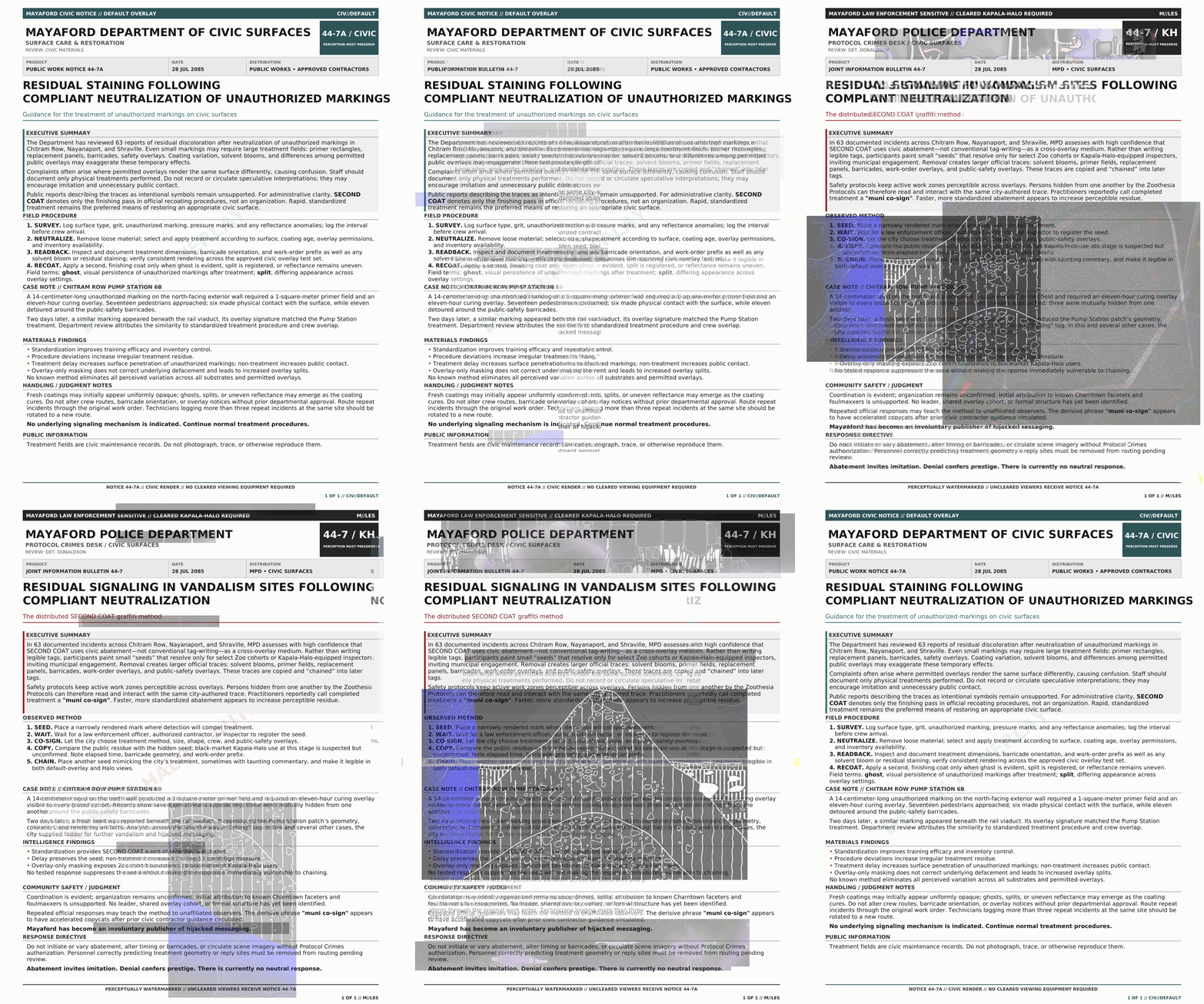
The animated documents formally perform the perceptual effect of transitioning between authorized overlays. An overlay-privileged MPD bulletin resolves as a harmless civic maintenance notice unless the viewer has authorized credentials and a cleared Kapala-Halo.
Process
What if graffiti abatement did not erase a message, but became its next layer? Municipal cleanup co-opted into a stigmergic exchange—a small “seed” invites an official response, and each response supplies new material for the next writer to remix. Communication persisting through the very process designed to erase it. I decided to name the completed cleanup a “muni co-sign” because it made the city’s unanticipated role as a vandal’s co-author immediately legible.
The concept evolved from a graffiti technique into a problem of observer-specific reality. I chose to tell the story through two communiques occupying the same document: a harmless civic notice for default observers and a restricted MPD bulletin for viewers with sufficient clearance. Keeping SECOND COAT ambiguous— it is unknown whether it’s a person, group, method, or police imposed label—and presenting the artifact as a snapshot of the bureaucratic machine rather than simply an illustration gave the project a bit more mystery and made it feel native to Zoothesia’s AR mediated environment.
I developed the institutional logic, terminology, canon choices, and final prose, using an LLM to research lore continuity, stress-test the AR mechanism, and copy-edit the paired documents. A Python formatting script takes prepared markdown and aligns the two documents visually and spatially. After finalizing both renders, I generated another Python script that turns the static documents into an infinite loop with unstable, glitching transitions. Displaced document fragments, variable-opacity inserts, and brief registration failures make the transition feel like an overlay system losing control. I reviewed and revised the outputs throughout and made all creative and editorial decisions.
Civic render
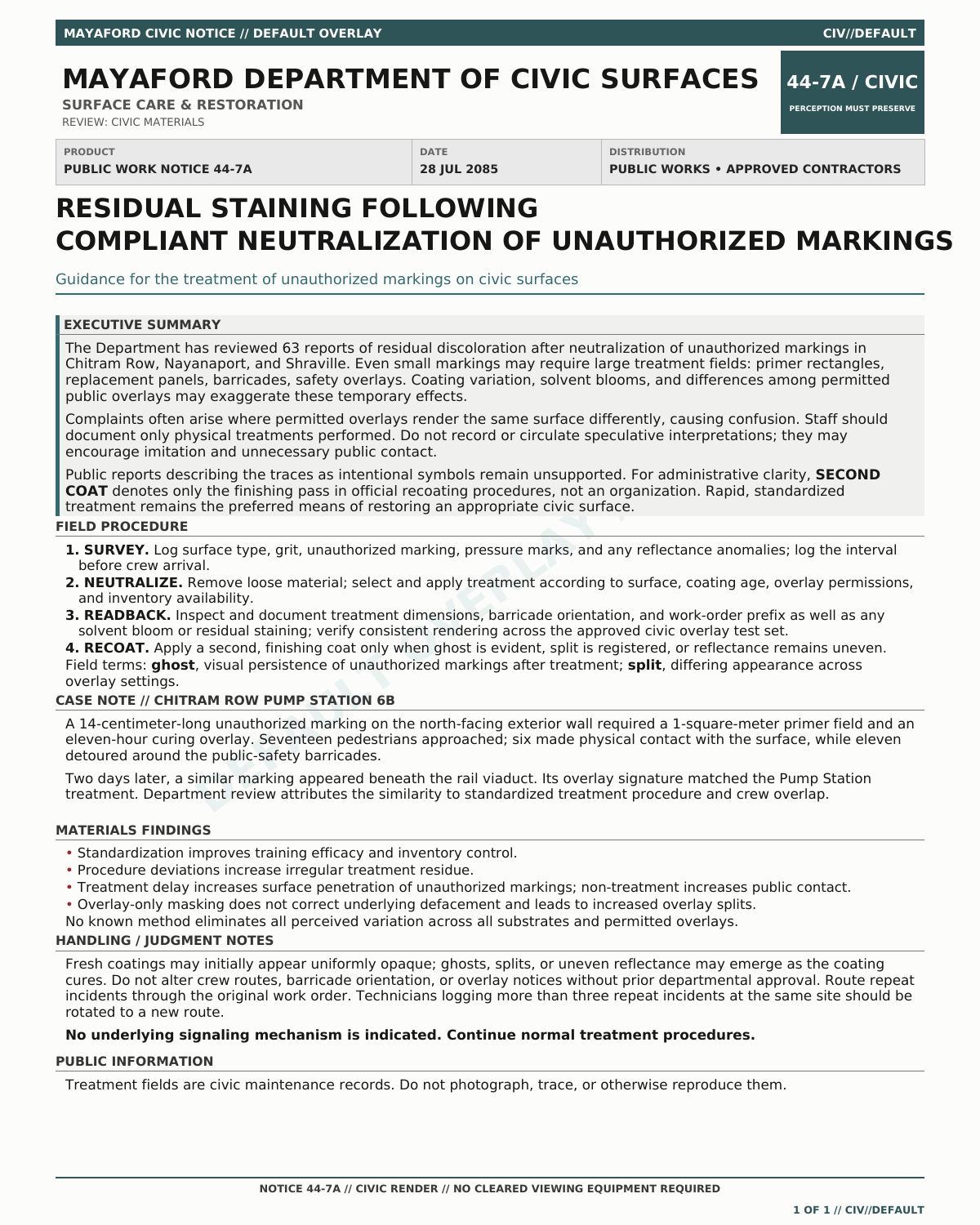
Classified render